The first village you encounter when heading north out of Tulkarem is Shweika. It is a rather large village which is almost incorporated into the city itself. Despite being home to Tulkarem's only amusement park, Megaland, Shweika is more famous, or rather infamous, for something completely different. Its car thieves.
Men from Shweika steal cars from Israel, bring them to the village and take them apart. Car carcasses can be found everywhere. The parts are sold, at a very reasonable price, and people travel from all over the West Bank to get a new door or replace a broken wind shield.
The fame of Shweika car thieves reached new heights when a song about them was released. And they're well known on the other side of the green line as well. Apparently, it is more common that the Israeli Defense Force (IDF) is raiding the village looking for car thieves than fighters.
Saturday, January 12, 2008

Friday, January 11, 2008
Into the seam zone
 Catching a ride in Jalal's tractor
This morning, the very charming Guilluame Fardel flashed his smile at the soldiers by the Deir al-Ghusun gate, told a little lie, and got us through the gate and into the seam zone. We were therefore able to spend the whole morning with farmers from Deir al-Ghusun - drinking tea, visiting families in Arab Israeli villages, farming, and drinking more tea. It was a thoroughly enjoyable way to spend a clear and sunny morning.
 Jamal making tea
 Guillaume working on the irrigation system
 More tea and scarecrow construction in the sun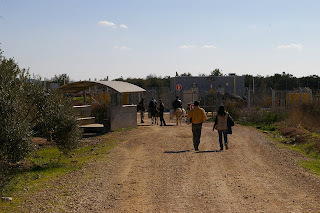
Back to the gate where trouble awaits
Returning home around noon proved a lot more tricky than getting into the seam zone though. The soldiers were very displeased that we had been able to pass earlier in the morning. They spent a good half hour checking with their superiors if we could go back. In the end, they let us go, with our promise never to do it again without coordinating with the District Command Office beforehand. I have a strong feeling that we will never be able to pass again for as long as this particular unit serves at the gate...
Thursday, January 10, 2008
Welcome, Mr. President!
So, how do I know Bush is here?
- The amount of flying checkpoints (mobile random checkpoints) have increased dramatically the last few days. There were four such checkpoints from Tulkarem to Ramallah on Sunday, making the total number of checkpoints for a return trip fourteen. Surely, it must be even worse today when he is actually in Ramallah. I'm glad I don't have to find out.
- The security at checkpoints seems to have been stepped up. Monday was the first day I had two soldiers pointing their machine guns at me for no apparent reason whatsoever. Made me feel like I was under siege. It was not that bad though, although it was a little disconcerting to see that the usually nonchalant soldiers were shaking with fear.
- However, I find it more frightening when I meet less intelligent soldiers with too much power in their hands. Example:
- Q:"Why are you making the farmers lift up their shirts?"
- A: "Have you not seen the movie The Kingdom?".
- The number of cars queuing at Anabta checkpoint to go from Tulkarem towards Ramallah and Jerusalem, vary between 50 to 200 every afternoon/evening. The queue never disappears, and sometimes it takes hours to pass. And ahead of the travellers another checkpoint awaits... And another...
- The roads to the southern West Bank are closed for Palestinian vehicles when Bush is here. As if the restriction of movement wasn't tough enough from before.
- More military incursions around the West Bank and an increase in arrests the past weeks. Could it be that Israel is trying to stir up some trouble? Just so that they can "prove" to Bush that the Palestinians are troublemakers and terrorists?
Wednesday, January 9, 2008
How to make farming hot

Khaled. A farmer from Deir Al Ghusun. Movie-star material according to Guillaume. I will not disagree.
Khaled forgot his ID today, so he decided to take us around and show us some very old houses near the Wall. He also showed us a demolished house, where you still could see the laundry left behind by the bulldozers. It is prohibited to live within 1 km of the Wall, so all the houses that were considered too close were demolished. The affected people did not receive any compensation for their losses. Only the bill for the demolition.

House demolitions are still a major problem for many Palestinians, especially in Area C (as decided in the Oslo Accords), where the Palestinians require permits from Israel to build houses. This is rarely granted and in any case a very slow process. But since people need more space, they start building houses without permission. The Israeli army then comes and tears it down. But the people try again. And the bulldozers are sent back in. And so it continues...
But back to Khaled. A month before we came, he had some trouble at the gate. He was waiting in line with his tractor when an officer walked by and suddenly decided to confiscate it. There was no reason other than the whim of a moody soldier. Khaled then received a fine of 6000 shekels (9000 Norwegian kroner). With the help of ICRC, he hired a lawyer and started a court process to get his tractor back. Just before the court case started, the Israeli military said he could get his tractor back if he paid half the fine. He decided to comply and is now in possession of his red tractor again.
It could have made a nice Erin Brockovich-style movie, with a Palestinian ending of course. Anyway, farming suddenly seems less unattractive...
Monday, January 7, 2008
Gate 623
 Monitoring the gate
When Israel built their so-called 'security fence' (from now on referred to as the Wall) in 2003, the farmers of Deir Al Ghusun and the surrounding area were cut off from their agricultural land. A major proportion of their fields are now in the seam zone - the land between the Wall and the green line. Gate 623 is the only way for the farmers in Deir al-Ghusun to access their fields. But it is just open three times a day, for two and a half hours in total.
However, you cannot just go through. You need a permit. This is issued by the Israeli authority and is rather hard to obtain. In order to get one, you need to prove that you own land on the other side of the Wall. Even then, you might not get a permit. They usually issue one permit to one person in each family, regardless of the size of their fields. And in some cases, the person granted a permit happens to be the most unsuitable person in the family, like a child or an elderly person. In one family, they allegedly gave the permit to the blind brother.
Another example of how the Israeli authority is bending the rules, is by questioning the lineage of inheritance. Land is registered to the name of the original owner, but after four generations, the ties to the original owner's name disappears as a result of how they name their children in Palestine. So, when people are unable to prove their ownership, the Israeli authority will not grant permits.
 "Morratryne" - Waiting for the gate to open
For us, gate watching means that we have to get up at 4.30AM every morning to be at the gate before 6.00AM. There, we make sure the gate is opened on time and we monitor the soldiers' behaviour. And we count: men, women, children, tractors, donkeys and carts. Why? Because United Nations Office for the Coordination of Humanitarian Affairs (OCHA, hence OCHA-week) wants numbers on how many people actually pass the gate. Before the construction of the Wall, there used to be around 180 people working on the fields every day. Now there are about 60, mainly as a result of the permit system.
The permit system is intricate and arbitrary, and I could go on and on about the many injustices the Palestinian farmers face in order to reach the land that they legally own. Quite often, the farmers have to lift up their shirts and the bottom of their trousers, as well as have their body and belongings searched. Imagine being treated as a criminal every day on your way to work. It is beyond frustrating and humiliating.
I believe that Israel might be digging their own grave with their overtly security-centred policies. Palestinian antagonism against their country will only grow and it is the perfect environment for desperation and anger to breed. I feel it too. The whole thing makes you wanna throw rocks.
Tuesday, January 1, 2008
Another week, another year
New Years Eve
Happy new year to those of you who care about us entering 2008! The Palestinians sure don't. There was no visible celebration whatsoever here in Tulkarem yesterday. However, there was a rather big Fatah-celebration taking place in the streets, guns and flags ablazing.

We had a few other EAs over for dinner (and charades). And some of our Palestinian friends dropped by, bemused by our obsession to mark the beginning of a new year with a party. Luckily for me, there was a Tony Parker look-a-like among them. Unluckily for the guys there were no Eva Longoria-esque ladies in sight...

Misconceptions
We have talked to quite a few Palestinians by now. Most of the time, they like to discuss politics and the occupation. It is odd listening to the many preconceptions some of them have about Israelis and Judaism. The same goes for many of the Israelis we've met. They have quite a few ideas about the Palestinians, some of which, to me, seem rather irrational. There are so many misconceptions floating about that it makes your head spin.
However, Palestinians and Israelis have something in common. The self-image on both sides is to a large degree soaked in a sense of victimhood. And the enemy image is quite often demonised beyond recognition. The result seems to be two very unhealthy societies, both of which breed destructive forces.
Missionary, collaborator, or Chinese?
Other misunderstandings are also common in our daily life in Palestine. Walking around with a cross on our backs, we can understandably be construed as missionaries. So sometimes we are met with apprehensive distrust.
But it is even worse when Palestinians think we're collaborating with the soldiers at checkpoints. Soldiers are often very interested in talking to us, and we've often gotten into discussions with them. For Palestinians, it is easy to view this as some sort of socialising. So now we try to avoid talking to the soldiers for a longer period of time unless neccessary.
Quite often, we encounter people who want us to help them get a visa. For some reason, they think we have a big say in our home countries. I've tried telling them that the Norwegian Ministry of Foreign Affairs couldn't give a toss about my demands, but I'm not sure they believe me.
Quite often, we encounter people who want us to help them get a visa. For some reason, they think we have a big say in our home countries. I've tried telling them that the Norwegian Ministry of Foreign Affairs couldn't give a toss about my demands, but I'm not sure they believe me.
But most annoying of all, is when people insist I'm Chinese or Japanese. Kills me every time. Seriously.
The biggest misconception
The language barrier often creates problems too. We will tell someone that we cannot make it to an appointment and they will ask us when we will be there. With some people this seems to be chronic.
The language barrier often creates problems too. We will tell someone that we cannot make it to an appointment and they will ask us when we will be there. With some people this seems to be chronic.
Case in point: Nassim. Nassim is a 21-year old student at Kadoorie University whom we met through our Arabic teacher. His English is far from flawless, and my Arabic is close to non-existant, but if I've understood him right, he's studying a joint degree in electrical engineering and massage (!). However, I think the truth might have gotten lost in translation somewhere.
Nassim has a wonderful family, who have opened up their home to us and treated us like we're part of their family. In this case, I believe the language barrier has been working in my favour, because they think I'm "sweet". It is a description I doubt anyone who really knows me would use. Actually, I would call this the greatest misconception of them all.

Nassim has a wonderful family, who have opened up their home to us and treated us like we're part of their family. In this case, I believe the language barrier has been working in my favour, because they think I'm "sweet". It is a description I doubt anyone who really knows me would use. Actually, I would call this the greatest misconception of them all.
With eldest sister Sarab and her niece
 Eldest brother Mohammad with his nephew and niece
Subscribe to:
Posts (Atom)